

DIMEAR Technology
HERO SECTION
Eyebrow label: The Science of Sound
Headline: Hear the Way Nature Intended.
Subheadline: Most hearing devices fight your biology. Dimear works with it — using the same pathway your skull has always used to carry sound to your brain.
CTA Button: Shop Dimear → | Learn How It Works ↓
SECTION 1 — THE CORE CONCEPT
Eyebrow: Bone Conduction Technology
Headline: Sound doesn't need your ear canal.
Body: Here's something most people don't know: your bones are already conducting sound right now.
Every time you hear your own voice — when you speak, hum, or chew — a significant portion of what you perceive travels not through your ear canal, but through the bones of your skull, vibrating directly into your cochlea. That's why your voice sounds different on a recording. The air version is what everyone else hears. The bone version is what you hear.
Dimear takes that same natural pathway and uses it intentionally.
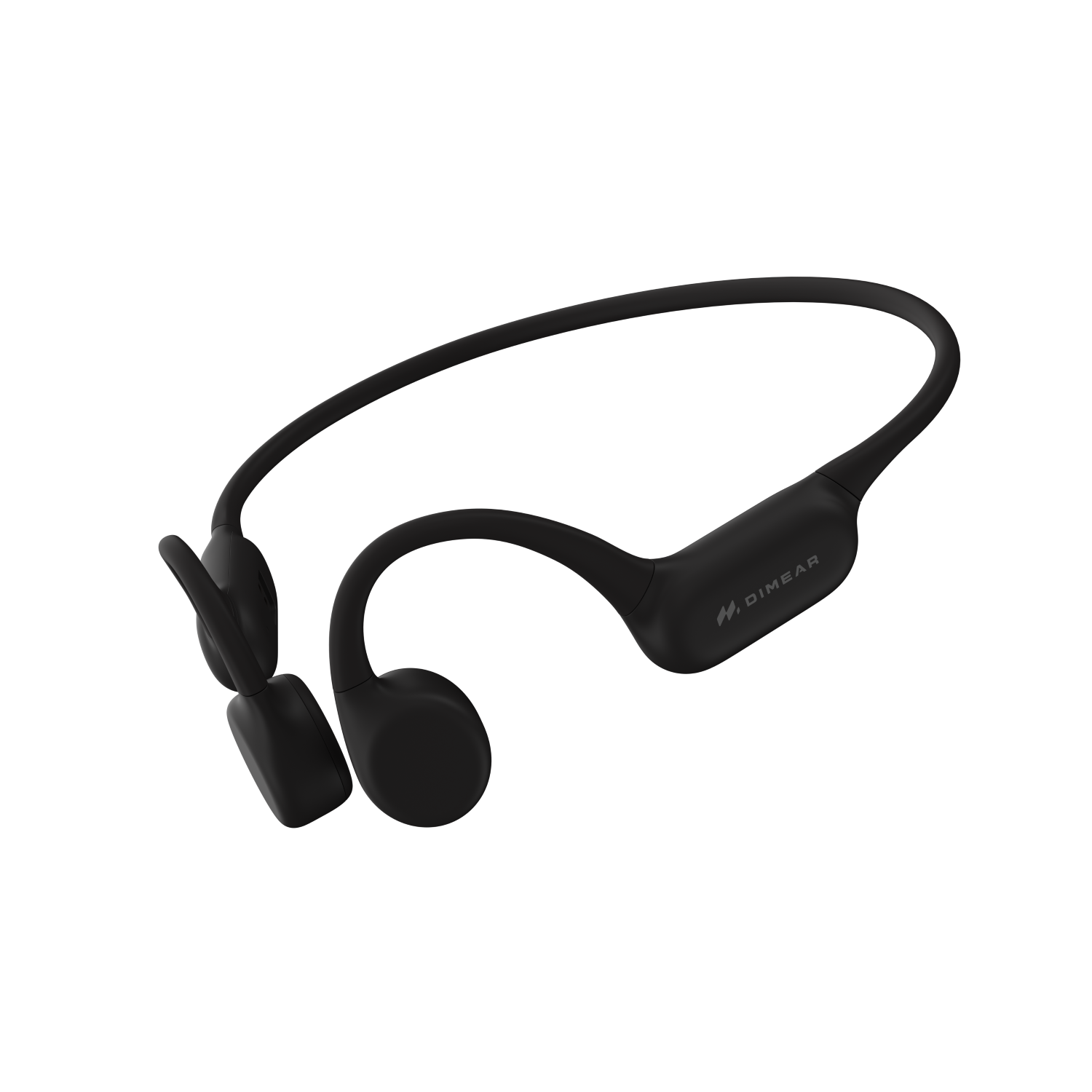
Our transducers rest against your cheekbones and generate precisely calibrated micro-vibrations that travel through bone directly to the cochlea — your inner ear's sound-processing chamber — bypassing the outer and middle ear entirely. The result is sound that feels natural, not amplified. Present, not forced.
SECTION 2 — SIDE-BY-SIDE COMPARISON
Eyebrow: Traditional vs. Dimear
Headline: Two completely different approaches to hearing. One clear winner.
Subheadline: Traditional hearing aids were designed around what was technically possible 50 years ago. Dimear was designed around how the human body actually works.
Comparison Table
| Traditional Hearing Aid | Dimear Bone Conduction | |
|---|---|---|
| How sound travels | Amplified air vibrations pushed into a blocked ear canal | Micro-vibrations through bone directly to the cochlea |
| Ear canal | Blocked or partially blocked | Completely open |
| Ambient awareness | Reduced — world sounds muffled | Full — hear everything around you |
| Feedback (whistling) | Common, especially near phones | None — no in-ear speaker |
| Ear canal irritation | Frequent complaint for long-term wearers | Zero — nothing enters the ear |
| Fitting process | Requires audiologist appointment | Self-fitted at home via Dimear app |
| Cost | $2,000 – $7,000 per pair | From $199 |
| Who it's designed for | All hearing loss types | Mild-to-moderate hearing loss |
| Suitable after ear surgery | Often not | Yes — bypasses the affected area entirely |
SECTION 3 — HOW IT WORKS (STEP BY STEP)
Eyebrow: Inside the Technology
Headline: Four steps from silence to sound.
Step 01 — Capture
Title: Sound enters the transducer.
Body: Dimear's dual titanium transducers continuously pick up ambient sound — speech, TV audio, phone calls, and the full acoustic environment around you. At the same time, Bluetooth streaming delivers audio directly from your phone or TV without any signal loss.
Step 02 — Process
Title: The signal is shaped for your ears.
Body: Before the sound reaches you, it passes through Dimear's onboard DSP (Digital Signal Processor). This chip analyzes the incoming audio in real time, boosts speech frequencies (500Hz–4kHz), suppresses background noise, and balances amplification levels so that speech is always clear — never harsh or distorted. On the Pro Max, an AI noise-cancellation layer runs simultaneously, continuously distinguishing speech from background noise and adjusting within milliseconds.
Step 03 — Conduct
Title: Vibration travels through bone.
Body: The processed signal drives our 12mm titanium transducers to vibrate at the exact frequencies your cochlea needs to receive. Those vibrations pass through the mastoid bone — the dense bone just behind and around your ear — directly into the fluid-filled cochlea. Hair cells in the cochlea convert the vibration into electrical signals. The signal never touches your ear canal.
Step 04 — Hear
Title: Your brain receives natural sound.
Body: Your auditory nerve carries the electrical signal to your brain's auditory cortex, where it is interpreted as sound. Because the cochlea receives the signal in its natural vibrational form, your brain processes bone-conducted audio as normal hearing — not as amplification, not as electronics. Just sound. The way it was always supposed to arrive.
SECTION 4 — THE DIMEAR TRANSDUCER
Eyebrow: Engineering Detail
Headline: The 12mm component that changes everything.
Body: At the heart of every Dimear device is a custom-engineered 12mm titanium transducer. This is not a speaker. It does not produce air pressure waves. It produces calibrated mechanical vibration — and the precision of that vibration is what separates a bone conduction device that works from one that merely exists.
We obsessed over four things during development:
Frequency accuracy. Human speech lives between 500Hz and 4kHz. Our transducer is tuned to deliver maximum efficiency across that exact range — not a broad consumer audio profile, but a clinical speech-first frequency response. Consonants, vowels, and the subtle tonal differences between similar words are all preserved.
Low harmonic distortion. Distortion in a hearing device doesn't just sound bad — it makes speech harder to understand, not easier. We engineered Dimear's transducer to maintain less than 1% total harmonic distortion (THD) across its operating range, so what you hear is a clean representation of what was said.
Consistent contact force. For bone conduction to work effectively, the transducer must maintain consistent, gentle pressure against the cheekbone. Our titanium frame is precision-tensioned to hold steady contact during normal movement without causing fatigue or discomfort during extended wear.
Vibration isolation. Without isolation, vibrations from the transducer can "leak" into the frame and create unwanted resonance. Dimear's transducer is mounted in a proprietary dampening housing that directs vibration where it's needed — into your skull — and absorbs stray energy before it reaches the frame.
SECTION 5 — KEY SPECS AT A GLANCE
Eyebrow: Technical Specifications
Headline: Built to perform. Engineered to last.
Dimear Pro S
| Spec | Detail |
|---|---|
| Amplification | Up to 32 dB |
| Frequency Range | 20Hz – 20kHz |
| Speech Frequency Boost | 500Hz – 4kHz (primary amplification range) |
| Transducer Size | 12mm titanium |
| Total Harmonic Distortion | < 1% |
| Connectivity | Bluetooth 5.3 |
| Battery Life | 8 hours continuous use |
| Charge Time | ~1.5 hours (magnetic cable) |
| Water Resistance | IP55 (sweat and light splash proof) |
| Weight | 28g |
| Noise Reduction | Passive DSP |
| App Control | Yes — iOS & Android |
| Regulatory Clearance | FDA Class II |
| Warranty | 2 years |
Dimear Pro Max
| Spec | Detail |
|---|---|
| Amplification | Up to 40 dB |
| Frequency Range | 20Hz – 20kHz |
| Speech Frequency Boost | 500Hz – 4kHz with AI-enhanced clarity |
| Transducer Size | 12mm titanium (upgraded driver) |
| Total Harmonic Distortion | < 0.8% |
| Connectivity | Bluetooth 5.3 |
| Battery Life | 12 hours continuous use |
| Charge Time | ~2 hours (magnetic cable) |
| Water Resistance | IP67 (submersion up to 1 meter / 30 min) |
| Weight | 32g |
| Noise Reduction | AI-powered active noise cancellation |
| App Control | Yes — iOS & Android (extended EQ) |
| Regulatory Clearance | FDA Class II |
| Warranty | 2 years |
SECTION 6 — THE DIMEAR APP
Eyebrow: Personalization
Headline: Your hearing profile. In your hands.
Body: No two people lose hearing the same way. Age-related hearing loss typically affects high frequencies before low ones. Noise-induced loss creates a distinctive notch around 4kHz. One ear may be different from the other.
The Dimear app lets you tune your device to your specific hearing profile — in 10 minutes, at home, without a clinical appointment.
Feature 01 — Hearing Assessment Take a 5-minute in-app hearing screening that maps your sensitivity across key frequencies. Dimear uses your results to pre-configure amplification levels tailored to your actual loss profile — not a generic default setting.
Feature 02 — Manual EQ Control Six-band equalizer lets you fine-tune treble, midrange, and bass independently for left and right channels. If you need more clarity on high-pitched consonants like "s" and "f," you can dial it in yourself.
Feature 03 — Environment Presets Switch instantly between presets optimized for different listening situations: Conversation Mode (restaurant, family dinner), TV Mode (optimized for speech-heavy programming), Outdoor Mode (reduced wind noise, enhanced speech focus), and Phone Mode (vocal clarity for calls).
Feature 04 — Battery & Device Management Real-time battery status, firmware update notifications, device rename, and multi-device pairing management — all in one place.
SECTION 7 — WHO DIMEAR IS DESIGNED FOR
Eyebrow: Clinical Fit
Headline: Is Dimear right for your hearing?
Body: Bone conduction amplification is most effective for specific types and degrees of hearing loss. Here is a straightforward guide.
Dimear works best for:
Mild-to-moderate sensorineural hearing loss The most common form of age-related hearing loss, caused by natural changes to inner ear hair cells over time. Dimear's targeted amplification at speech frequencies directly addresses this pattern. If you find yourself asking people to repeat themselves, turning up the TV, or struggling in group conversations — this is most likely your situation.
Conductive hearing loss Caused by conditions affecting the outer or middle ear — chronic ear infections, fluid buildup, perforated eardrum, or certain structural differences. Because Dimear bypasses the outer and middle ear entirely, it can be highly effective even when the ear canal or eardrum is compromised.
Single-sided deafness (mild-to-moderate cases) Bone conduction can help route sound from a weaker side by conducting vibrations through the skull to the stronger cochlea. Results vary depending on the nature and degree of single-sided loss.
People who are uncomfortable with in-ear devices If you have tried traditional hearing aids and found them uncomfortable, occlusive, or difficult to maintain — open-ear bone conduction is a fundamentally different experience worth trying.
Dimear may not be the right fit if:
You have severe or profound hearing loss. Bone conduction amplification at Dimear's range (up to 40 dB) may not provide sufficient gain for severe loss (55+ dB HL) or profound loss. In these cases, we recommend consulting an audiologist about higher-powered devices or cochlear implant evaluation.
Your hearing loss is primarily caused by cochlear damage at high amplification requirements. If your audiologist has recommended amplification above 40 dB, Dimear's current range may be insufficient as a standalone solution.
If you are unsure, our support team can review a copy of your audiogram (hearing test results) and give you an honest assessment of whether Dimear is the right match — before you purchase.
SECTION 8 — SAFETY & CERTIFICATIONS
Eyebrow: Regulatory Standards
Headline: Cleared. Tested. Trusted.
FDA Class II Medical Device Clearance Dimear is registered and cleared by the US Food and Drug Administration as a Class II hearing device. This means it has met the FDA's safety and efficacy requirements for personal sound amplification and hearing assistance — a standard most consumer audio products do not meet.
ISO 60268 Acoustic Testing All Dimear devices are tested to international acoustic standards governing frequency response, distortion levels, output limits, and consistency across production units.
IP55 / IP67 Water & Dust Resistance Independently tested to IEC 60529 ingress protection standards. IP55 (Pro S) protects against dust and directional water spray. IP67 (Pro Max) adds protection against submersion up to 1 meter for 30 minutes.
RoHS & CE Compliance All materials used in Dimear comply with Restriction of Hazardous Substances (RoHS) directives. Dimear devices are CE marked for European market standards.
Bluetooth SIG Certification Dimear's Bluetooth 5.3 module is certified by the Bluetooth Special Interest Group, ensuring interoperability, stability, and compliance with radio frequency emission standards.
A note on long-term safety: Bone conduction technology has been used in hearing devices, military communications, and professional audio equipment for over 60 years. There is no evidence in the clinical literature that routine use of bone conduction devices at normal amplification levels causes harm to hearing, bone structure, or cranial tissue. Dimear operates well within established safety thresholds for both vibration intensity and output volume.
SECTION 9 — THE HISTORY OF BONE CONDUCTION
Eyebrow: 200 Years of Science
Headline: This technology is older than the telephone.
Body: Bone conduction is not a startup's clever invention. It is a phenomenon that scientists and engineers have understood — and put to use — for two centuries.
1820s — Beethoven Ludwig van Beethoven, almost completely deaf in his final decade, is said to have attached a rod to his piano and clenched it between his teeth while composing — conducting the piano's vibrations through his jawbone to his cochlea. He could not hear through his ears. He heard through his bones. He wrote his Ninth Symphony this way.
1876 — Alexander Graham Bell Bell's early telephone experiments included bone conduction receivers — devices held against the skull rather than the ear — as he worked to understand how vibration could carry intelligible speech.
1930s – 1970s — Military and industrial applications Bone conduction headsets became standard equipment for aircraft pilots, tank crews, and military communications operators in environments too loud for conventional headphones. Bone conduction allowed clear communication in 120+ dB noise environments without competing with ambient audio.
1980s – 2000s — Clinical hearing devices Bone Anchored Hearing Aids (BAHAs) — surgically implanted bone conduction devices — became an established clinical option for patients with conductive hearing loss and single-sided deafness. The clinical efficacy of bone-conducted amplification was validated by decades of audiological research.
2010s — Consumer bone conduction headphones Companies like AfterShokz (now Shokz) popularized consumer bone conduction headphones for athletes who wanted to hear music without blocking their ears during outdoor activities. This brought bone conduction manufacturing to mass scale, dramatically improving transducer quality and reducing costs.
Today — Dimear Dimear applies clinical-grade bone conduction engineering — the precision of medical hearing devices, the wearability of consumer technology, and the accessibility of direct-to-consumer pricing — to address the most underserved hearing health need in America: mild-to-moderate hearing loss in adults who cannot afford or won't accept traditional hearing aids.
We did not invent bone conduction. We perfected it for the people who need it most.
CLOSING CTA SECTION
Headline: The science is solid. The only thing left is trying it.
Body: Every Dimear comes with a 45-day free trial. If it doesn't change the way you hear the world, send it back — free return shipping, full refund, no questions asked.
CTA Buttons: Shop Dimear Pro S — $399.99 → Compare All Models →
Trust signals: ✓ FDA Class II Cleared ✓ 45-Day Free Trial ✓ HSA / FSA Eligible ✓ Free US Shipping ✓ 2-Year Warranty ✓ 45,000+ Customers


